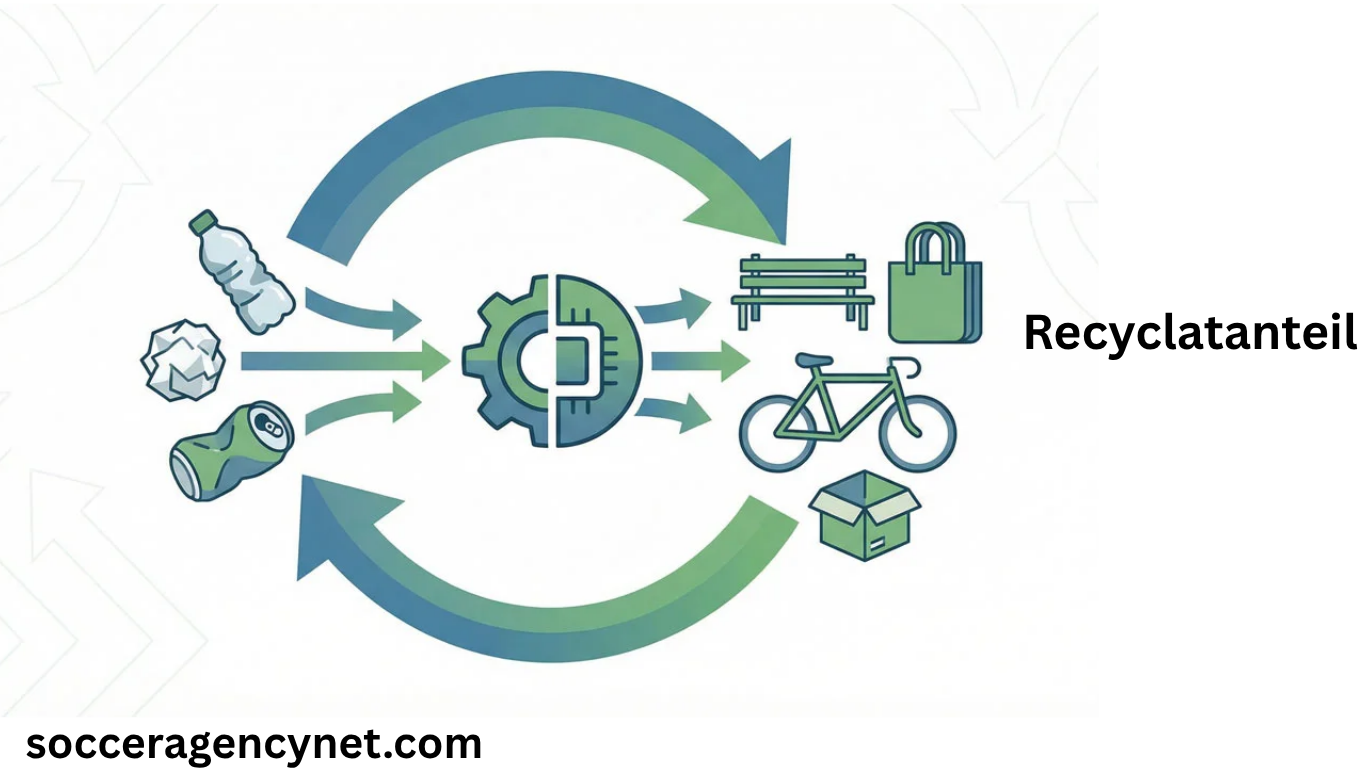
Recyclatanteil: Meaning, Calculation, Recycled Content, and Why It Matters
Recyclatanteil is a German term that is becoming increasingly relevant in discussions about recycling, sustainable manufacturing, packaging, plastics, product design, and the circular economy. In simple English, Recyclatanteil refers to the percentage or share of recycled material contained in a product, component, packaging item, or raw material.
The idea sounds simple, but it answers an important question that is often misunderstood: how much of the material in a finished product actually came from recycled sources?
This is different from asking how much waste consumers put into a recycling bin.
A recycling rate usually describes what happens to waste after disposal. Recyclatanteil looks at the other side of the process. It asks how much recycled material has actually been incorporated into a new product.
For example, imagine a plastic container that weighs 100 grams. If 30 grams of its material comes from qualifying recycled material and the remaining 70 grams comes from virgin material, its recycled content would be 30%.
This simple measurement has become increasingly important because governments, manufacturers, retailers, and consumers are looking for practical ways to reduce dependence on virgin raw materials.
The concept is also becoming more important from a regulatory perspective. In the European Union, new packaging rules establish minimum recycled-content requirements for certain plastic packaging, with targets beginning in 2030 and becoming more demanding in 2040.
For American readers, the subject is equally relevant even though terminology and regulations can differ by state and product category. California, for example, has specific postconsumer recycled-content requirements for certain plastic beverage containers.
This comprehensive guide explains what Recyclatanteil means, how recycled content is calculated, the difference between post-consumer and post-industrial recyclate, why the measurement matters, how companies verify it, what challenges manufacturers face, and how consumers can understand recycled-content claims.
What Does Recyclatanteil Mean?
Recyclatanteil literally describes the share of recyclate contained in a product or material.
The English term most closely associated with Recyclatanteil is “recycled content.”
In practical terms, it tells you how much of a product’s material comes from recycled sources rather than newly extracted or produced raw materials.
A basic example makes the concept easy to understand.
Suppose a manufacturer produces a 200-gram plastic component.
If 80 grams of that component is recycled material, the recycled content is:
80 ÷ 200 × 100 = 40%
The product therefore has a Recyclatanteil of 40%.
The remaining 60% consists of non-recycled material.
This calculation is generally expressed by mass, although the exact calculation method can depend on the applicable standard, regulation, product type, and reporting rules.
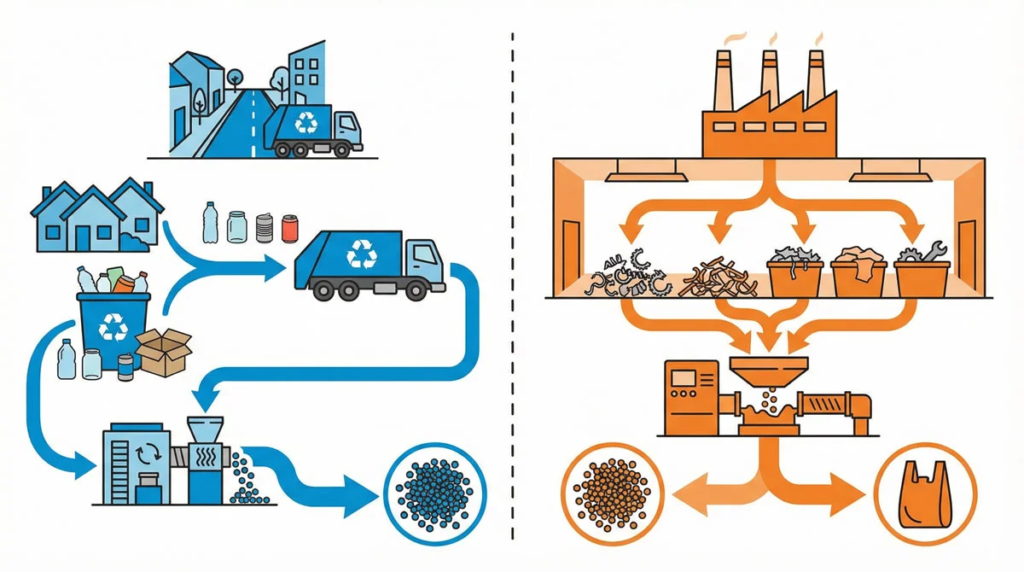
Modern recycled-content guidance commonly distinguishes between different sources of recyclate, including post-consumer and post-industrial material.
Recyclatanteil in Simple English
If you are seeing the word Recyclatanteil on a German product description, technical document, packaging specification, or sustainability report, think of it as:
“the percentage of recycled material in the product.”
For example:
- 0% recycled content means the product contains no qualifying recycled material.
- 25% recycled content means one quarter of the relevant material comes from recycled sources.
- 50% recycled content means half comes from recycled material.
- 100% recycled content means all of the relevant material is recycled, assuming the claim is defined and verified according to the applicable rules.
The important word is “relevant.”
A product may contain several different materials.
A package might contain plastic, paper, metal, ink, adhesive, and other components. A statement about recycled content may refer to the entire product, a specific material, or a particular component.
That is why a percentage should always be read together with its scope.
Recyclatanteil vs. Recycling Rate
One of the most important distinctions is between recycled content and recycling rate.
These terms describe different stages of the material cycle.
Recyclatanteil asks:
“How much recycled material is inside the new product?”
A recycling rate asks something closer to:
“How much collected waste is actually recycled?”
These measurements should not be treated as interchangeable.
A country could have a high recycling collection rate while manufacturers still use relatively little recycled material in new products.
The reverse can also happen in a specific product category.
This distinction is important because collecting waste does not automatically guarantee that the material will return to manufacturing.
Recycling involves collection, sorting, processing, quality control, and manufacturing.
Recyclatanteil focuses on the point where recycled material has successfully entered the production system.
How Is Recyclatanteil Calculated?
The basic formula is straightforward:
Recycled content percentage = mass of recycled material ÷ total relevant material mass × 100
For example, suppose a manufacturer produces 1,000 kilograms of plastic products.
If 350 kilograms come from qualifying recycled plastic, the recycled content is:
350 ÷ 1,000 × 100 = 35%
The Recyclatanteil is therefore 35%.
However, real manufacturing calculations can become more complicated.
Companies may have multiple production lines, different materials, different suppliers, production losses, additives, coatings, and different definitions of eligible recycled material.
That is why professional recycled-content claims often require documented calculation methods rather than a simple estimate.
Why Mass Matters
Recycled content is commonly expressed by mass because weight provides a measurable physical basis.
For example, a manufacturer cannot simply say that a product “looks 50% recycled.”
The percentage should be connected to a defined quantity of material.
This is particularly important for plastics and packaging because a small amount of one material can visually represent a large part of a product even when its actual mass is much smaller.
A mass-based calculation reduces some of this confusion.
However, manufacturers still need to clearly define which material is being measured.
Post-Consumer Recyclate
Post-consumer recyclate, often abbreviated PCR, comes from products or materials that have already been used by consumers and then collected for recycling.
Examples can include:
- Used PET beverage bottles
- Used household plastic containers
- Recovered packaging
- Used consumer electronics plastics
- Recycled household paper
- Other materials recovered after consumer use
Post-consumer recycled content is especially important because it creates demand for material that has completed a consumer-use cycle.
A simplified circular pathway looks like this:
Consumer uses product → product becomes waste → material is collected → material is sorted → material is processed → recyclate is produced → recyclate becomes part of a new product.
This is one of the clearest examples of the circular economy in action.
Post-Industrial Recyclate
Post-industrial recyclate, sometimes called pre-consumer recycled material depending on the context, comes from manufacturing processes rather than ordinary consumer waste.
Examples might include:
- Production offcuts
- Manufacturing scrap
- Plastic rejected during production
- Clean industrial process waste
- Unused material recovered from manufacturing
This material can be valuable because it is often cleaner and more predictable than mixed post-consumer waste.
For example, a factory may generate clean plastic trim during production. That material can potentially be collected, reprocessed, and returned to manufacturing.
The environmental value can still be meaningful, but it should not automatically be treated as equivalent to post-consumer recycling.
That distinction is particularly important when a company makes sustainability claims.
Why Post-Consumer Content Often Gets More Attention
Post-consumer material helps create demand for recovered consumer waste.
This matters because recycling systems need buyers.
If collected plastic has no profitable market, recycling facilities may have difficulty processing it economically.
When manufacturers commit to purchasing recycled material, they can create a stronger market for recyclers.
This can support the broader recycling system.
In simple terms, recycling needs both supply and demand.
Consumers and collection systems create the supply.
Manufacturers create much of the demand.
Recyclatanteil connects those two sides by showing how much recycled material actually enters new production.
Why Recyclatanteil Matters for the Circular Economy
The circular economy aims to keep materials in productive use for as long as possible.
Traditional linear production often follows this pattern:
Extract → manufacture → use → discard.
A more circular system attempts to create a loop:
Extract or recover → manufacture → use → collect → recycle → manufacture again.
Recycled content is important because it closes part of that loop.
A product made with recycled material is not necessarily perfectly circular. It may still contain virgin resources, require energy, involve transportation, or eventually become waste.
But recycled content is one measurable indicator that recovered material has returned to production.
This is why Recyclatanteil can be useful as part of a wider sustainability assessment.
Recyclatanteil and Virgin Raw Materials
Virgin material is material that has not previously been used as recycled feedstock for the product in question.
For plastics, virgin resin is typically produced from primary petrochemical feedstocks.
For metals, primary material can come from mined ores.
For paper, virgin fiber comes from newly sourced fiber rather than recovered paper.
Increasing recycled content can reduce the need for some virgin feedstocks.
However, the exact environmental benefit depends on the material, production method, energy source, transport, processing requirements, and other factors.
Therefore, it is better to say that recycled content can reduce reliance on virgin raw materials rather than claim that every percentage point automatically produces the same environmental benefit.
Recyclatanteil in Plastic Products
Plastic is one of the most important areas where Recyclatanteil is discussed.
Plastic products can be manufactured using recycled polymers from several sources.
Common examples include recycled PET, recycled HDPE, recycled PP, and other polymer types.
Recycled plastic can be used in products such as:
- Bottles
- Containers
- Packaging
- Automotive components
- Furniture
- Household goods
- Industrial parts
- Construction products
- Textiles
The amount and type of recycled content that can be used depends heavily on product requirements.
A packaging product requiring high purity may have stricter material requirements than a non-contact industrial component.
Recycled PET and Recyclatanteil
PET is one of the best-known examples of recycled plastic.
Used PET beverage bottles can be collected, sorted, washed, processed, and converted into recycled PET feedstock.
This recycled PET can then be used in new products.
In some applications, recycled PET can be used for new packaging, while in others it can be turned into fibers or other products.
The quality of the recovered material matters greatly.
Contamination, color, polymer degradation, additives, and mixing with incompatible materials can affect performance.
This is why recycling is not simply a matter of melting old plastic and automatically receiving identical new plastic.
Recyclatanteil in Packaging
Packaging is a major focus of recycled-content policy because enormous quantities of packaging are produced and discarded every year.
The European Union’s Packaging and Packaging Waste Regulation establishes minimum recycled-content requirements for certain plastic packaging.
Under the regulation, several categories of plastic packaging must reach specified minimum recycled-content levels by 2030, with higher levels scheduled for 2040.
The exact requirement depends on packaging type.
For example, the regulation sets a 30% minimum for certain contact-sensitive PET packaging, 30% for single-use plastic beverage bottles, and 35% for other plastic packaging categories by 2030, subject to the regulation’s conditions and exceptions.
This demonstrates why Recyclatanteil is becoming more than a marketing concept.
It is increasingly becoming a measurable regulatory requirement in some markets.
Recyclatanteil and the European Union
European policy has increasingly focused on both recycling and recycled content.
Earlier EU packaging legislation established recycling targets for different packaging materials, while newer rules place additional emphasis on the amount of recycled material used in packaging.
The newer approach recognizes an important problem.
It is not enough to collect and recycle waste.
There must also be a market for the recycled output.
Recycled-content requirements can help create that market by requiring or encouraging manufacturers to use recycled material.
This creates a connection between waste management and product manufacturing.
Recyclatanteil in the United States
The US does not have one nationwide recycled-content percentage that applies to every product.
Requirements vary by material, product category, and state.
This is important for American businesses because a company selling products in multiple states may need to understand different rules.
California provides a clear example.
California’s beverage-container rules include minimum postconsumer recycled plastic requirements for certain plastic beverage containers. The applicable standards have changed over time, and current rules include a 25% average requirement for certain covered containers during 2025 through 2029 and a 50% requirement beginning in 2030, subject to the law’s scope and provisions.
California has also adopted additional requirements affecting certain plastic-containing beverage packaging formats.
This shows why companies should not assume that a single recycled-content number applies across the entire United States.
Recyclatanteil and Product Claims
A company might advertise a product by saying:
“Made with 50% recycled material.”
That statement sounds simple, but consumers should ask what the 50% refers to.
Does it mean:
- 50% of the entire product?
- 50% of the plastic?
- 50% of the packaging?
- 50% post-consumer material?
- 50% recycled content by weight?
These are different claims.
Clear labeling should make the scope understandable.
A strong sustainability claim is specific rather than vague.
Recyclatanteil and Greenwashing
Recycled-content claims can help consumers make better choices, but vague environmental language can also create confusion.
Greenwashing occurs when environmental benefits are presented in a misleading, exaggerated, or incomplete way.
For example, a product containing a small amount of recycled material should not be presented in a way that makes consumers believe the entire product is recycled.
Similarly, a product with recycled content may still have other environmental impacts.
Recyclatanteil is therefore best treated as one metric rather than a complete sustainability score.
A product with 80% recycled content is not automatically better in every environmental category than a product with 40% recycled content.
Other factors matter.
Recyclatanteil Does Not Mean Recyclable
This is another major distinction.
Also read:Hart Violet Braun: Biography, Age, Parents, Family, and What We Know
A product can contain recycled material but still be difficult to recycle after use.
For example, a package could contain recycled plastic but use multiple layers, adhesives, inks, or incompatible materials that complicate future recycling.
The reverse can also be true.
A product may be technically recyclable but contain no recycled content.
Therefore:
Recycled content asks where today’s material came from.
Recyclability asks what can happen to the product after it becomes waste.
Both concepts matter.
A truly circular approach considers both.
Recyclatanteil and Product Quality
Some people assume that adding recycled material automatically lowers product quality.
That is too simplistic.
The effect depends on the material, recycling process, contamination level, application, and manufacturing technology.
High-quality recycled materials can perform very well in many applications.
However, recycled feedstock can have different characteristics from virgin material.
For example, repeated processing can affect some polymers.
Manufacturers may therefore need to adjust processing conditions, formulations, additives, or blending ratios.
The objective is to achieve the required product performance while increasing the use of suitable recycled feedstock.
Why Manufacturers Cannot Always Use 100% Recycled Material
It is tempting to think that the best product would always contain 100% recycled material.
In some applications, that may be possible.
In others, it may not be practical or permitted.
Reasons can include:
- Material contamination
- Food-contact requirements
- Safety standards
- Mechanical performance
- Color requirements
- Odor
- Availability
- Processing limitations
- Regulatory requirements
- Product durability
- Insufficient recycling capacity
A responsible manufacturer should therefore choose a recycled-content level based on the product’s actual requirements rather than simply choosing the largest percentage for marketing purposes.
Recyclatanteil and Food Packaging
Food packaging presents special challenges.
Materials that come into contact with food must meet safety requirements.
Recycled material must therefore be processed and controlled carefully when it is intended for sensitive applications.
This is one reason why recycled-content targets can vary according to whether packaging is contact-sensitive.
The EU’s current packaging regulation reflects this distinction by establishing different recycled-content requirements for certain contact-sensitive packaging categories.
The important lesson is that recycled content cannot be considered separately from product safety.
Recyclatanteil and Automotive Manufacturing
The automotive industry is another area where recycled content can become increasingly relevant.
Vehicles contain large quantities of plastics, metals, textiles, glass, and other materials.
Manufacturers can potentially use recycled materials in components such as:
- Interior trim
- Underbody parts
- Floor coverings
- Seat fabrics
- Plastic housings
- Sound insulation
- Certain structural or non-structural components
The challenge is to balance recycled content with durability, safety, appearance, weight, and cost.
Because vehicles are expected to operate reliably for many years, material quality is critical.
Recyclatanteil in Electronics
Electronics also contain many materials that can potentially be recycled.
Recycled plastics may be used in housings and internal components.
Recycled metals can also enter manufacturing streams.
However, electronics are complicated products.
They may contain adhesives, flame retardants, coatings, mixed materials, and very small components.
This makes both recycling and recycled-content measurement more challenging.
A manufacturer seeking higher recycled content may therefore need to redesign components rather than simply replace virgin material with recyclate.
Recyclatanteil and Textiles
The concept also applies to clothing, carpets, upholstery, and other textile products.
Recycled polyester is one common example.
Used plastic bottles can be processed into PET-derived fibers.
Textile recycling can also recover fibers from old clothing and other textile waste.
But recycled fiber does not automatically mean a product is environmentally superior in every way.
Fiber quality, durability, washing behavior, microfibers, dyes, transportation, and end-of-life options all matter.
Again, Recyclatanteil is a useful metric, but it is not the complete environmental story.
Benefits of Increasing Recyclatanteil
A higher recycled-content share can offer several potential benefits.
Reduced Demand for Virgin Material
Using recycled feedstock can reduce the need for some newly extracted or produced raw materials.
Stronger Recycling Markets
Manufacturers buying recyclate create demand for recycled material.
Better Material Circularity
Recycled content helps move materials back into production instead of treating them as one-time resources.
Support for Recycling Infrastructure
Stable demand can encourage investment in collection, sorting, cleaning, processing, and recycling technologies.
Regulatory Compliance
In markets with mandatory recycled-content standards, increasing Recyclatanteil can help manufacturers meet legal requirements.
Consumer Transparency
Clear recycled-content information can help consumers understand the material history of a product.
Challenges of Increasing Recyclatanteil
Increasing recycled content is not always easy.
The largest challenge is often supply.
If manufacturers suddenly need large amounts of high-quality recycled material, recycling systems may not have enough suitable feedstock.
This can create competition for recyclate.
Another challenge is consistency.
Manufacturing requires predictable materials.
Recycled feedstock can vary depending on collection systems, sorting quality, contamination, color, and processing technology.
Cost is another factor.
High-quality recycling can require advanced equipment, energy, labor, testing, and quality control.
These challenges do not mean recycled content is impractical.
They mean that increasing it requires investment throughout the supply chain.
The Role of Recycling Infrastructure
A high Recyclatanteil cannot be achieved by manufacturers alone.
The entire system matters.
Consumers need ways to dispose of products.
Collection systems need to gather materials.
Sorting facilities need to separate them.
Recyclers need to process them.
Manufacturers need to purchase the output.
If one part of the chain fails, the supply of recycled material can shrink.
This is why recycled-content policy is closely connected to broader waste-management policy.
Recyclatanteil and the Supply Chain
Manufacturers increasingly need detailed information from suppliers.
A company cannot make a credible recycled-content claim without knowing what materials enter its factory.
Supply-chain documentation can include:
- Material specifications
- Supplier declarations
- Production records
- Batch information
- Recycled-content certificates
- Mass-balance records where applicable
- Audit documentation
- Testing results
The exact documentation depends on the product and applicable standard.
The broader lesson is simple: sustainability claims require evidence.
Measuring Recyclatanteil Correctly
Accurate measurement starts with a clear definition.
A company should determine:
- What product or component is being measured?
- Which materials are included?
- What counts as recycled material?
- Is the percentage based on total product mass or a specific material?
- Is post-consumer content separated from other recycled content?
- What calculation method applies?
- What evidence supports the result?
Without these decisions, two companies could report different percentages for similar products.
Standardized definitions improve comparability.
Standards and technical frameworks such as ISO 14021 and relevant European standards are often used when establishing recycled-content claims and verification approaches.
Recyclatanteil and Mass Balance
Some advanced recycling systems use mass-balance accounting.
This can become important when recycled feedstocks are introduced into complex chemical or industrial production systems.
Instead of physically tracking every recycled molecule into a specific finished product, the system tracks the amount of eligible recycled feedstock entering a production network and allocates an appropriate share to products according to defined accounting rules.
This is different from physically segregated recycled material.
Because mass-balance claims can be difficult for consumers to understand, companies need clear explanations and credible certification or accounting systems.
The key point is that “recycled content” can involve different chain-of-custody approaches, and the methodology should be disclosed when it materially affects the claim.
How Consumers Can Understand Recycled-Content Labels
Consumers do not need to become recycling experts to interpret recycled-content claims.
Start by looking for a percentage.
Then check what the percentage describes.
For example:
“Made with 50% postconsumer recycled plastic”
is more specific than:
“Eco-friendly packaging.”
The first statement tells you something measurable.
The second is broad and difficult to evaluate without additional information.
Also look for material information.
If the package is plastic, determine which plastic is being discussed.
If it is a product made from several materials, find out whether the percentage applies to the whole product or one component.
Is Higher Recyclatanteil Always Better?
Not automatically.
This is one of the most important insights when discussing recycled content.
Also read:Crypings Com: What It Is, What It Covers, Features, Safety, and How to Use It
A higher percentage is often desirable because it means more recycled material is being used.
But the complete environmental impact depends on other factors.
For example, a product might contain a high percentage of recycled material but have a very short useful life.
Another product might contain less recycled content but last much longer and be easier to recycle at the end of its life.
Transportation, manufacturing energy, durability, repairability, toxicity, and end-of-life options can all affect the overall picture.
Therefore, recycled content should be viewed as an important metric, not a universal environmental ranking.
Recyclatanteil and Product Design
The easiest time to increase recycled content is often before a product is designed.
Engineers can select materials that are compatible with recycled feedstock.
They can reduce unnecessary material combinations.
They can design components for easier separation.
They can avoid unnecessary coatings or additives that interfere with recycling.
This is known as design for recycling or design for circularity.
The strongest strategy is therefore not simply “add more recyclate.”
It is:
Design the product so recycled material can be used effectively and the product can be recovered again later.
The Difference Between Recycled and Recyclable
The words are similar, but their meanings are different.
Recycled means the material has already been recovered and used again.
Recyclable means the product or material has the potential to be collected and processed through an appropriate recycling system.
A product can be:
- Recycled but difficult to recycle again
- Recyclable but made entirely from virgin material
- Both recycled and recyclable
- Neither
The ideal circular design tries to achieve both high-quality recycled content and practical recyclability.
Recyclatanteil and Waste Reduction
Recycled content should also be distinguished from waste prevention.
The waste hierarchy generally places reducing unnecessary consumption and waste ahead of recycling.
If a company can eliminate unnecessary packaging, that may be more effective than simply making the same unnecessary packaging with recycled material.
This does not make recycled content unimportant.
Instead, it shows that sustainable design usually requires several strategies at once.
Reduce unnecessary material.
Reuse when practical.
Recycle suitable materials.
Use recycled feedstock where possible.
Design products for longer life.
These strategies can reinforce each other.
Future Trends in Recyclatanteil
Recycled content is likely to remain an important topic in manufacturing.
Several trends are shaping the future.
One is stronger regulation.
The EU’s packaging regulation is a major example of governments moving from general recycling goals toward specific recycled-content requirements.
Another trend is better sorting and recycling technology.
Improved optical sorting, chemical recycling, advanced mechanical recycling, and better contamination control may increase the amount of usable recyclate.
Digital product information may also make material composition easier to track.
Finally, consumer expectations are changing.
More shoppers want specific information rather than vague environmental language.
This creates pressure for companies to measure and document their claims.
Recyclatanteil and the Future of Sustainable Manufacturing
The long-term importance of Recyclatanteil goes beyond one percentage.
It represents a change in the way companies think about materials.
Instead of viewing waste as the end of a product’s life, manufacturers can view certain waste streams as future raw materials.
That change requires new business models, better infrastructure, stronger quality control, and better product design.
It also requires realistic expectations.
Recycling cannot solve every environmental problem.
But when recycling systems work effectively and manufacturers actually use the recovered material, recycled content can become an important part of a more circular economy.
A Simple Example of Recyclatanteil in Everyday Life
Imagine buying a 500-gram plastic storage container.
The manufacturer says it contains 40% postconsumer recycled plastic.
This means approximately 200 grams of the relevant plastic material comes from postconsumer recycled sources, assuming the percentage is calculated against the full 500-gram material basis.
The remaining 300 grams comes from other material sources.
Now imagine the manufacturer also says the container is recyclable.
These two claims answer different questions.
The first tells you about the product’s material history.
The second tells you about its potential future after use.
Together, the claims provide a more complete picture.
Why Recyclatanteil Is Becoming More Important
The world has limited resources.
At the same time, modern economies produce enormous amounts of material waste.
Recycling provides a way to recover some of that value.
But recycling only becomes truly useful when recovered materials return to productive use.
That is where Recyclatanteil becomes important.
It measures the connection between recycling and manufacturing.
Instead of stopping the conversation at “Was this product recycled?”, it asks a more useful question:
“How much recycled material is actually present in the new product?”
That shift in focus is one of the most valuable ideas behind recycled-content measurement.
Final Thoughts
Recyclatanteil is a useful way to understand how much recycled material actually enters a new product. Unlike a recycling rate, which focuses on what happens to waste, recycled content focuses on what happens after recovered material becomes a manufacturing input. This distinction is becoming increasingly important as businesses, governments, and consumers move toward a circular economy. A higher Recyclatanteil can reduce reliance on virgin materials, strengthen markets for recyclers, and support more circular production, but it should never be treated as the only measure of sustainability. The strongest approach combines recycled content with durable product design, responsible material choices, practical recyclability, efficient production, waste prevention, and transparent environmental claims.
Frequently Asked Questions About Recyclatanteil
What is the English word for Recyclatanteil?
The closest common English term is “recycled content.” It describes the percentage or share of recycled material contained in a product or material.
Can Recyclatanteil be more than 100%?
No. A conventional recycled-content percentage cannot exceed 100%. A value above 100% would indicate a calculation, definition, or reporting error.
Does recycled content guarantee that a product is environmentally friendly?
No. Recycled content is one sustainability indicator. Product durability, energy use, transportation, toxicity, recyclability, and other factors also matter.
Is postconsumer recyclate better than post-industrial recyclate?
They serve different purposes. Postconsumer material comes from products used by consumers, while post-industrial material generally comes from manufacturing processes. Postconsumer content can be especially valuable because it helps create demand for recovered consumer waste.
How can a company prove its Recyclatanteil?
Companies can use documented material records, supplier declarations, production data, calculations, audits, certifications, testing, and applicable chain-of-custody methods. The exact evidence depends on the product, market, standard, and regulatory requirement.